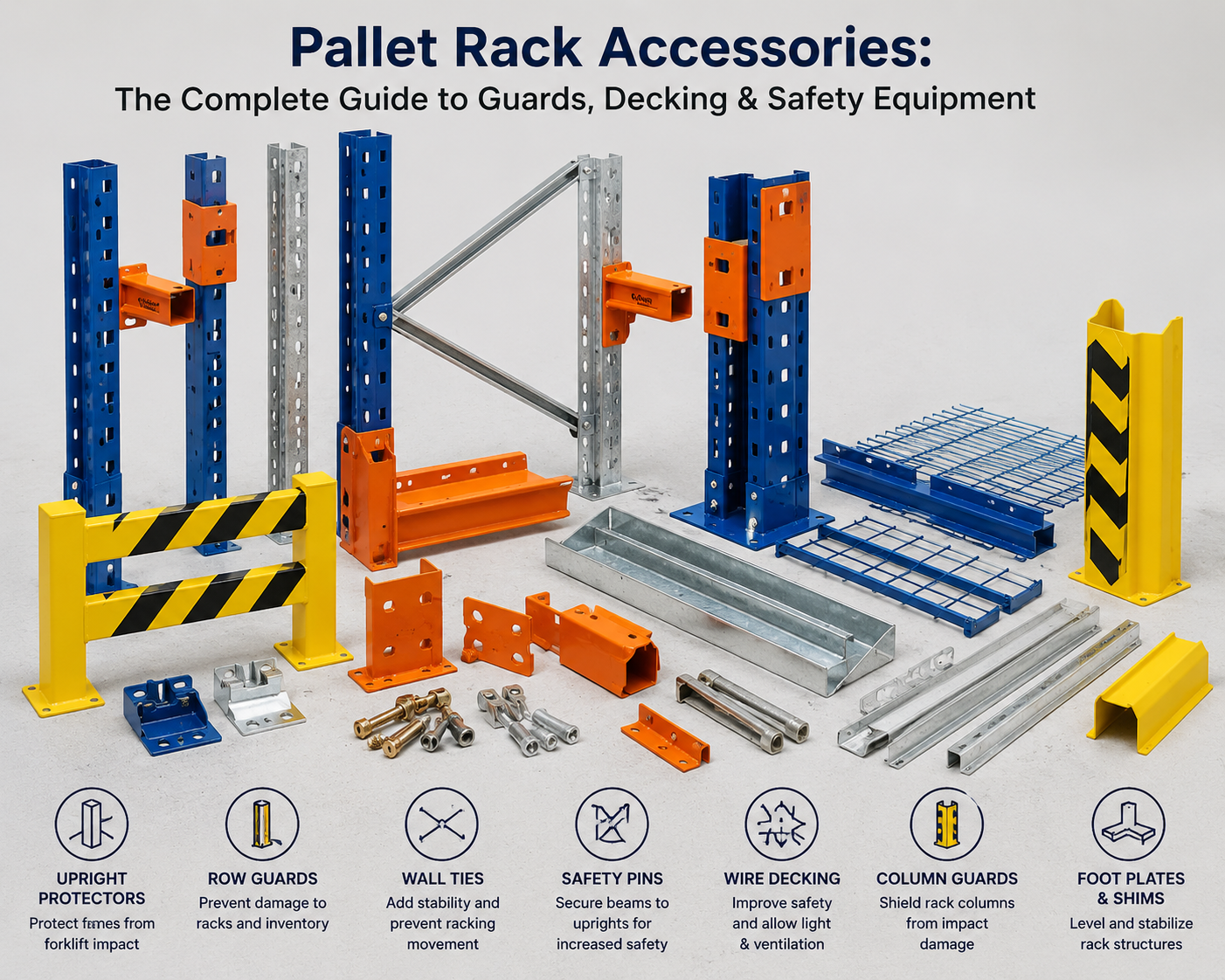
A pallet racking system is never truly complete the moment the last beam snaps into place. The accessories that protect it, keep it compliant, and make it operationally safe are equally important to your installation's long-term performance — and skipping them is one of the most expensive mistakes in warehouse setup.
8 Accessories Covered
🏛️
Column Guards
🚧
End-of-Row Guardrails
⬛
Wire Decking
↔️
Row Spacers
🕸️
Safety Netting
🔒
Beam Safety Pins
📋
Load Capacity Placards
━
Pallet Supports
⚠️
Structural Safety
Column guards and guardrails prevent the most common causes of rack failure — forklift impact and lateral drift
📋
OSHA Compliance
Load placards and beam safety pins are required by OSHA and ANSI MH16.1 — missing either creates immediate exposure
📦
Operational Integrity
Wire decking and safety netting ensure product is stored safely per OSHA 29 CFR 1910.176
Most operators who forego column guards, guardrails, and row spacers end up paying far more within 12–24 months through rack damage repairs, OSHA citations, and product loss than those accessories would have cost at installation. This guide covers every major accessory category: what it does, when it's required, what it costs, and how to specify the right option for your operation.
Why Pallet Rack Accessories Are Not Optional
Three categories of accessory are effectively mandatory in any active warehouse. The rest are strongly recommended. Here is the distinction that matters:
🛡️
Structural Safety
Column guards, row spacers, and end-of-row guardrails prevent the most common causes of rack structural failure. Racks without these are structurally vulnerable from day one of operation — forklift impact and gradual lateral drift are both foreseeable and preventable.
⚖️
OSHA Compliance
Load capacity placards and beam safety pins are required by OSHA's general duty clause and ANSI MH16.1 respectively. Missing either creates an immediate compliance exposure that can result in citations, fines, and insurance coverage complications following an incident.
📦
Operational Integrity
Wire decking, pallet supports, and safety netting ensure product is stored safely and stably. OSHA 29 CFR 1910.176 requires products to be stored to prevent falling or collapse — accessories are the practical means of meeting this requirement in a dynamic warehouse environment.
Accessory #1
🏛️
Column Guards & Post Protectors
Absorb forklift impacts at upright bases — the most critical and most frequently damaged rack point
#1 Most ImpactfulBolt-On InstallationSteel or HDPE$30–$80 each
Column guards are the single most impactful rack accessory for active warehouses. The base of each upright is the most structurally critical point in the system — and the most likely to be struck by forklifts, pallet jacks, and carts during normal daily operations.
1
Bolt-on guards attach directly to the upright base plate — steel or heavy-duty HDPE polymer options available
2
When a forklift clips the upright, the guard absorbs the impact energy before it can deform the steel column
3
Some designs are engineered as sacrificial — replace after impact, protecting the upright and indicating an incident occurred
Hardware Cost
$30–$80 per guard depending on material and column size. Specify by upright column width and base plate dimensions.
Recommended Placement
Every upright within 3 feet of an aisle. High-traffic main aisles warrant guards on every aisle-facing upright in the system.
Tip: Install column guards on every upright within 3 feet of an aisle — including back-to-back row uprights. High-traffic counterbalance forklift aisles warrant guards on every aisle-facing upright.
Accessory #2
🚧
End-of-Row Guardrails
Protect the most vulnerable rack point — exposed aisle-end uprights struck by turning forklifts
End-of-row guardrails protect the most vulnerable point of any rack layout: the exposed uprights at the end of each aisle run. These aisle-end uprights are most likely to be struck by forklifts turning into and out of aisles — and an aisle-end upright collapse can trigger a progressive collapse of the entire row.
1
A steel guardrail assembly is anchored to the floor at both ends of each rack row, spanning the full aisle opening
2
The guardrail absorbs forklift impact loads before they reach the upright — designed as a sacrificial element
3
Replace the guardrail after major impact rather than the upright — significantly lower cost and faster restoration
Hardware Cost
$150–$400 per set (pair of rails per aisle end). Specify by aisle width — must span the full aisle opening.
Anchor Requirement
Anchor design must match your concrete thickness and strength — confirm during purchase, not after installation.
Recommended: Install end-of-row guardrails on every rack row regardless of aisle width or forklift type. In facilities with counterbalance forklifts — the widest, heaviest equipment — they are particularly critical.
Accessory #3
⬛
Wire Decking
The most widely used rack storage surface — required for NFPA 13 sprinkler compliance in most facilities
NFPA 13 CompliantMost Common SurfaceOpen-Mesh Design$30–$80/panel
Wire decking is a welded wire mesh panel resting on beam pairs to provide a stable, visible surface for stored pallets, cases, or loose product. It is required or strongly recommended in the majority of pallet rack applications — and NFPA 13 fire suppression compliance makes open-mesh wire decking the only safe standard choice.
Why Wire Over Solid Decking Recommended
Water passes through mesh during a fire event — maintaining sprinkler coverage on all levels below
Visibility — staff can visually confirm product and beam condition through the deck surface
Weight — wire decking is lighter than solid alternatives, reducing structural load
Ventilation — allows air circulation for temperature-sensitive or refrigerated product
Low Cost, High ValueOften OverlookedSteel Tube or Strap$20–$50 each
Row spacers maintain the correct back-to-back distance between paired rack rows — preventing the gradual lateral drift that causes rack lean and eventual structural instability. They are inexpensive, easy to install, and one of the most overlooked accessories in warehouse design.
1
A steel tube or strap connector links back-to-back uprights at the top of the frame, locking the spacing permanently
2
Without spacers, forklift vibration and dynamic loading gradually move rows apart over months and years
3
Gradual lean reduces structural capacity and eventually risks collapse — invisible until it's too late
Hardware Cost
$20–$50 per spacer. Specify by required back-to-back distance for your pallet depth and overhang requirements.
Installation Rule
At least one spacer per frame pair — two per pair on tall systems over 16 feet to maintain structural stability.
Accessory #5
🕸️
Pallet Rack Safety Netting
Prevents product falling from the rear of racks into pedestrian zones or restricted areas
OSHA 29 CFR 1910.176Polypropylene or Steel$3–$8/sq ft
Safety netting prevents product from falling off the rear of pallet rack positions into restricted areas or pedestrian zones. It is required in facilities where the back of the rack is accessible to workers and in any configuration where product instability creates a falling object hazard.
1
Polypropylene mesh netting attaches to upright frames at the rear face — standard for most applications
2
Steel safety bars (rigid alternative) provide higher strength for heavier product configurations
3
Measured by the total rear face area to cover — height × width of each bay needing protection
Hardware Cost
$3–$8 per sq ft for standard polypropylene netting including mounting hardware.
OSHA Reference
OSHA 29 CFR 1910.176(b) — material stored in tiers must be stable and secure against falling.
Required when: the back of your rack is accessible to workers, adjacent to pedestrian walkways, or where product instability during forklift operations could create a falling object hazard.
Accessory #6 — Mandatory
Beam Safety Pins (Beam Locks)
Beam safety pins are the locking devices that prevent beams from dislodging when struck by a forklift from below. They are the smallest accessory in this guide and one of the most critical — with mandatory compliance requirements under both ANSI and OSHA standards.
🔒
Mandatory Safety Requirement
Beam Locking Device — Required on Every Beam Connection
Governed By
ANSI MH16.1 & OSHA 29 CFR 1910.159
ANSI MH16.1 and OSHA mandate that all beam connections must include the manufacturer's specified locking device. This is non-negotiable from both a safety and legal liability standpoint. Missing safety pins are among the most commonly cited violations in rack safety inspections — and among the most easily avoided.
✓
Add beam safety pin verification to your post-installation checklist — every beam, every bay
✓
Assign a second crew member to independently verify pin engagement on each completed row
✓
Confirm both ends of every beam are positively locked before any loading begins
✓
Re-verify pins after any beam height adjustment during ongoing operations
✓
Use manufacturer-specified pins only — do not substitute generic fasteners for rated safety pins
Hardware Cost
Included with new beams; $2–$5 each for replacement. Always use the manufacturer's specified pin for your upright and beam model combination.
Key Rule
Do not substitute generic fasteners for rated safety pins — ANSI MH16.1 requires the manufacturer's specified locking device, not a generic substitute.
Accessory #7 — OSHA Required
Load Capacity Placards
Load capacity placards are posted signs showing the maximum permitted load per bay and per beam level for your installed rack configuration. Required by OSHA's general duty clause — and the primary tool for preventing overloading in day-to-day warehouse operations.
Maximum Bay Capacity
24,000 lbs
Total load all beam levels combined — per ANSI MH16.1 upright rating for this installed configuration
Maximum Per-Level Capacity
5,500 lbs
Maximum load per beam pair at any single level — UDL basis, for the installed beam model and length
Installed Configuration
8-ft bay × 20-ft upright
Ratings apply to this specific installed configuration only — must be updated if beams are reconfigured
Number of Beam Levels
4 levels
Capacity ratings are based on this level count — adding or removing levels requires a new placard
⚠️ Every time beam heights are reconfigured, product weights change significantly, or components are replaced — the placard must be updated to reflect the new configuration before the system is reloaded. Operating with an outdated placard is an OSHA violation.
Hardware Cost
$25–$60 per placard. Most manufacturers provide with new system purchases. Order replacements from your rack supplier to ensure values match your engineered system.
Placement Requirement
Posted at the end of each aisle or bay — legible from normal forklift operating position or from standing at the aisle end.
Accessory #8
━
Pallet Supports (Cross Bars)
Intermediate support bars for non-standard pallets, bridging gaps, or heavy concentrated loads
Non-Standard PalletsSteel Cross Bars$15–$35 each
Pallet supports are horizontal steel bars that span beam pairs at intervals within a bay — providing intermediate support points for non-standard pallet sizes or pallets with significant board gaps that could fall through wire decking.
1
Steel cross bars hook onto beam pairs and run parallel to the uprights within the bay
2
Provide additional support points for Euro pallets, custom footprints, or product with irregular bases
3
Help prevent pallet deflection under heavy concentrated loads that would otherwise create point loading on beams
When Needed
Non-standard pallet sizes that don't align with bay width, pallets with large board gaps, or heavy single-item loads needing intermediate support.
Hardware Cost
$15–$35 per support bar. Sized by bay width — confirm hook style matches your specific beam profile before ordering.
For a mid-sized selective rack installation of 100 bays, here is a realistic accessory budget covering all the major categories in this guide.
Accessory
Budget Range
Basis
Column Guards — all aisle-facing uprights
$1,200–$4,000
$30–$80 each × 40–100 uprights
End-of-Row Guardrails
$800–$2,400
$150–$400/set × 6–8 aisle ends
Wire Decking (if not included in rack purchase)
$3,600–$9,600
$30–$80/panel × ~600 panels (6/bay × 100 bays)
Row Spacers
$400–$1,000
$20–$50 each × 20–40 spacers
Safety Netting (rear face, where required)
$600–$2,000
Total rear face area × $3–$8/sq ft
Load Capacity Placards
$150–$400
$25–$60 each × 6–8 aisles
Beam Safety Pins (replacements, if not included)
Typically included
Supplied with new beams in most cases
Pallet Supports (if needed for your pallet type)
$300–$800
$15–$35 each × 20–40 support bars
Total Accessory Budget (100-bay system)
$7,050–$20,200
8–18% of typical hardware cost for 100 bays
Bottom line: Investing in a complete accessory package at installation time is significantly cheaper than the rack damage repairs, OSHA citations, product losses, and injury liability costs that accumulate in under-protected warehouse environments within 12–24 months.
Frequently Asked Questions
Common questions about pallet rack accessories, compliance requirements, and specifications.
01
Are column guards required by OSHA?
Column guards are not explicitly named in OSHA regulations, but OSHA's general duty clause requires employers to maintain a workplace free from recognized hazards. Forklift-to-rack impact is a well-recognized warehouse hazard, and column guards are the industry-standard control measure. Most rack safety inspectors and insurance carriers expect them to be present in any active warehouse facility.
02
Does wire decking affect fire sprinkler compliance?
Yes — this is a critical specification point. Wire mesh decking allows water from fire sprinklers to pass through to product stored below, maintaining coverage on all levels. Solid decking (plywood, solid steel) blocks this coverage and typically violates NFPA 13. Always specify open-mesh wire decking, and verify your specific decking specification with your fire protection engineer before purchasing.
03
When do I need to replace a column guard?
Replace a column guard after any visible impact that causes deformation, cracking, or loosening. Even if the guard appears intact, confirm the underlying upright has not been deformed before reloading. Some column guard designs are engineered as single-impact sacrificial elements — replace them after any significant impact regardless of apparent condition.
04
Can I use generic beam safety pins instead of manufacturer-specified ones?
No. Beam safety pins must be the manufacturer's specified locking device for your specific upright and beam model combination. Generic pins may appear to fit but are not rated or tested for the connection they secure. ANSI MH16.1 specifically requires the manufacturer's specified locking device — not a generic substitute.
05
How often do load capacity placards need to be updated?
Load capacity placards must be updated every time the installed configuration changes — including beam height reconfiguration, beam replacement with a different model, changes to the number of beam levels, or significant product weight changes. Operating with an outdated placard is an OSHA violation, regardless of whether the actual load is within the new configuration's capacity.
06
Do I need safety netting on all rack bays?
Not necessarily on all bays — safety netting is required where the rear of the rack is accessible to workers, adjacent to pedestrian walkways, or where product instability during forklift operations could create a falling object hazard. Review the layout of your facility and identify where workers or pedestrian traffic are exposed to the rear face of any rack row.
07
What is the best time to install rack accessories — during or after installation?
Always at the time of rack installation — not after. Installing accessories simultaneously with the rack is significantly faster, costs less in labor, and ensures the system is safe from the first day of operation. Retrofitting accessories after the fact in an active warehouse requires taking bays out of service and working around stored product — adding cost and disruption that far exceeds the savings from deferring the purchase.
Complete Your System Today
Ready to Complete Your Rack System with the Right Accessories?
United Rack Solutions supplies and installs the complete range of pallet rack accessories — column guards, guardrails, wire decking, row spacers, safety netting, load placards, and beam safety pins — for new and existing rack systems across Pennsylvania and surrounding states.