Types of Pallet Racking Systems: Complete Buyer's Comparison Guide | United Rack Solutions
Complete Buyer's Guide

Types of Pallet Racking Systems: Which One Is Right for Your Warehouse?

Not all pallet rack types are created equal. The right system depends on your SKU mix, forklift equipment, inventory rotation requirements, and budget. This guide covers all 7 major rack types — how each works, who it's for, and the trade-offs to understand before committing.
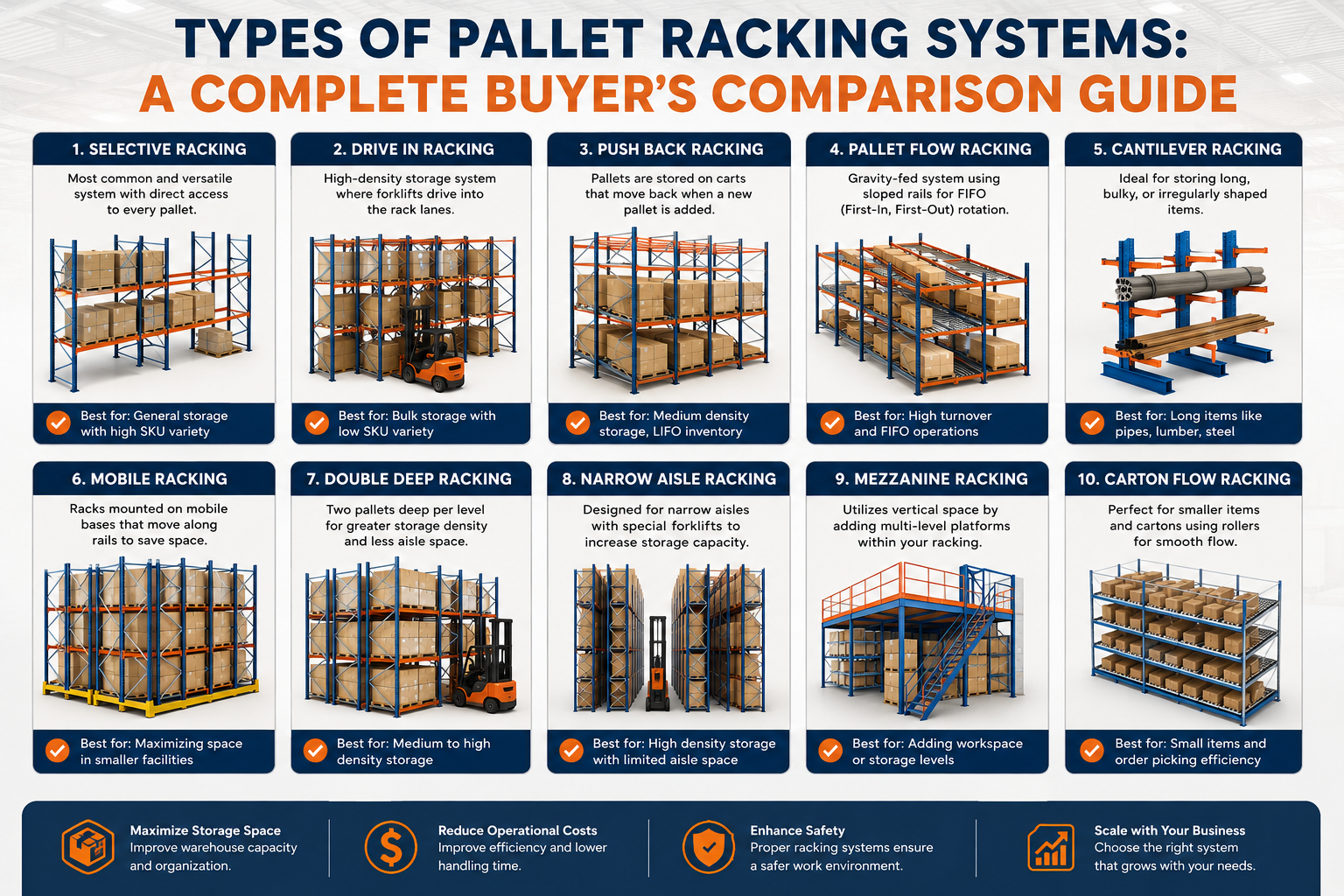
Selective
Drive-In
Push-Back
Pallet Flow
Carton Flow
Cantilever
Mobile Rack
Comparison of different types of pallet racking systems including selective, drive-in, push-back, pallet flow, carton flow, cantilever, and mobile warehouse racks.
Rack TypePallet AccessStorage DensityRotationBest ApplicationCost/Bay
Selective Pallet RackEvery Pallet
FIFO / LIFOMixed SKU, general warehousing$ Low
Drive-In RackLane Only
LIFO onlySingle-SKU bulk, cold storage$$ Med
Push-Back RackFront Pallet
LIFO onlyHigh density, moderate SKU count$$$ Med-Hi
Pallet Flow RackFront Pallet
FIFO onlyPerishables, date-sensitive product$$$ Med-Hi
Carton Flow RackFront Carton
FIFO onlyHigh-velocity order picking$$ Med
Cantilever RackEvery Arm
FIFO / LIFOLumber, pipe, furniture, irregular goods$$ Med
Mobile (Movable) Rack1 Aisle/Time
FIFO / LIFOLow-turnover, high space cost$$$$ High
Most warehouses combine 2–3 rack types — selective as the backbone, drive-in or push-back in the bulk zone, carton flow in the pick zone. The full breakdown of each type is below.
1
Selective Pallet Rack
The world's most widely used system — direct access to every pallet, maximum flexibility
Most CommonEvery PalletFIFO or LIFOLowest Cost
How It Works
1
Uprights and horizontal beams form open-face bays — each pallet position is individually accessible from the main aisle
2
Forklift accesses each pallet directly — no moving other pallets required at any time
3
Wire decking or pallet supports provide the storage surface at each adjustable beam level
4
Beam heights adjust in 1.5-inch increments to accommodate changing product sizes
Best For
Operations with high SKU diversity — multiple products needing independent daily access
Warehouses where FIFO rotation matters without system constraints
Facilities using standard counterbalance or reach truck forklifts
Operations that frequently reconfigure beam heights as product mix changes
First-time installations or operations with uncertain future requirements
Storage Density
Lower — 40–50% of floor space is aisle access. Highest pallet count per dollar invested.
Hardware Cost
$300–$600/bay new · $150–$300 inspected used. Lowest cost per bay of any rack type.
Forklift Needed
Standard counterbalance or reach truck. No specialized equipment required for standard heights.
Choose This IfYou have 10+ SKUs, mixed pallet weights, or need daily access to most inventory. If unsure which type is right, selective rack is the safest starting point and easiest to reconfigure as your operation evolves.
2
Drive-In Rack
Maximum storage density — forklift enters the rack structure to place and retrieve pallets
Highest Fixed DensityLIFO OnlySingle-SKU LanesCold Storage Favorite
How It Works
1
Uprights form deep structural lanes — no cross-bracing at pallet height allows forklift entry into the structure
2
Forklift drives into the lane and places pallets on horizontal rails running the full depth
3
New pallets push existing pallets deeper — last pallet in is the first pallet out (LIFO)
4
Drive-through variant: loading from one end, retrieval from the other — enables FIFO
Best For
Cold storage operations maximizing cubic storage per square foot of floor
Warehouses storing large quantities of the same SKU per lane
Seasonal goods, raw materials, or product shipping in full lane quantities
Operations where LIFO inventory rotation is acceptable
Breweries, beverage distributors, and building material suppliers
Major Trade-Off
Only the front pallet in each lane is accessible — reaching deeper pallets requires removing every pallet in front.
Hardware Cost
$500–$900/bay new · $250–$500 used. Density gain justifies premium in appropriate applications.
Key Risk
Forklift operates inside the structure — higher upright damage risk. Column guards and operator training are essential.
Choose This IfYou're storing large volumes of a few SKUs, LIFO rotation is acceptable, and maximizing pallet positions per square foot is the primary goal. Not suitable for mixed-SKU operations requiring frequent individual pallet access.
3
Push-Back Rack
High density with better product protection — forklift never enters the rack structure
Forklift Stays Outside2–6 Pallets DeepLIFOGravity-Fed Carts
How It Works
1
Each lane has inclined rails with nested rolling carts — forklift places the first pallet on the front cart
2
Second pallet pushes the first back along the inclined rails, nesting carts beneath each other
3
When front pallet is retrieved, gravity automatically brings the next pallet forward to the pick face
4
Forklift operates entirely from the front aisle — never enters the rack structure at any time
Best For
Operations with 20–50 SKUs — one dedicated lane per SKU
High-throughput operations needing better density than selective without losing front-face access
Cold storage with a broader product range than drive-in can accommodate
Food, beverage, and retail goods where LIFO rotation is acceptable
Operations that want reduced forklift contact with the rack structure
Major Trade-Off
LIFO only — true FIFO is not possible without unloading the full lane depth first.
Hardware Cost
$700–$1,200/bay new · $350–$700 used. Cart system adds significant hardware cost over selective.
Depth Limit
Most effective at 2–4 pallets deep. Beyond 5 pallets, cart complexity and pallet compatibility become constraints.
Choose This IfYou need more density than selective provides, have 20–50 SKUs with moderate-to-high turnover, LIFO is acceptable, and the density improvement generates measurable savings versus the additional hardware cost.
4
Pallet Flow Rack
True FIFO gravity-fed rotation — ideal for perishables, pharmaceuticals, and date-sensitive product
FIFO GuaranteedHigh DensityRoller ConveyorDate Code Compliance
How It Works
1
Inclined roller conveyor lanes slope gently from the loading aisle at the rear to the retrieval aisle at the front
2
New pallets are loaded from the rear — gravity moves them forward to the pick face automatically
3
Speed controllers or brakes on the rollers regulate pallet movement speed to prevent damage
4
Oldest product is always at the front — newest at the rear. Guaranteed FIFO every cycle.
Best For
Food, beverage, and perishable goods distribution requiring strict first-in, first-out rotation
Pharmaceutical and healthcare with expiry date management requirements
High-volume beverage or consumer goods operations
Operations where date-code compliance is a regulatory or contractual requirement
Operations needing both high density AND reliable FIFO simultaneously
Major Trade-Off
Highest hardware cost. Roller systems require ongoing maintenance — brake adjustment and lane clearing.
Hardware Cost
$800–$1,500/bay new. The roller conveyor system requires higher-quality components than passive rack types.
Pallet Requirement
Requires consistent, undamaged pallets in good structural condition. Broken boards can jam lanes.
Choose This IfYou store perishable, pharmaceutical, or date-sensitive product where FIFO is a regulatory or contractual requirement — and the density benefit justifies the higher hardware and maintenance cost versus selective rack.
5
Carton Flow Rack
High-velocity case picking at the carton level — typically combined with selective rack in pick zones
Case-Level PickingFIFONo Forklift at Pick FaceE-Commerce Favorite
How It Works
1
Roller or wheel conveyor lanes slope forward at a gentle angle within the rack bay
2
Cases are loaded from the rear or top and flow to the front pick face under gravity
3
Lane dividers separate individual SKU lanes — pickers select from the front without disturbing neighbors
4
Often installed in the bottom 2–3 beam levels of standard selective rack frames as a hybrid system
Best For
E-commerce fulfillment with high order volume and individual item picking
Grocery, pharmaceutical, and consumer goods picking operations
Operations running zone-based or wave-based picking strategies
Facilities looking to reduce picker travel time and improve throughput
Hybrid systems — carton flow in the pick zone, selective above for reserve stock
Key Distinction
A hand-pick system — not designed for pallet-level loading or retrieval by forklift at the pick face.
Hardware Cost
$200–$500 per lane installed in existing selective rack frames. Standalone systems vary by configuration.
Maintenance
Many SKU lanes require regular roller cleaning, lane clearing, and divider adjustment as SKU mix changes.
Choose This IfYou run a high-velocity picking operation with many small items and want to reduce picker travel time. Often paired with selective rack as a hybrid — carton flow at pick face, selective above for reserve/bulk stock.
6
Cantilever Rack
No front column — built specifically for long, bulky, or irregular goods standard pallet rack can't store
No Front ColumnAdjustable ArmsLong Goods SpecialistSingle or Double-Sided
How It Works
1
Vertical column towers anchor to the floor — no front vertical column obstructs the storage face
2
Horizontal arms extend from each tower at adjustable heights — arms can be added or repositioned
3
Goods rest across multiple arms — the item's length determines how many arms are spanned
4
Single-sided (wall-mounted) or double-sided (back-to-back, accessed from both sides)
Best For
Lumber yards, building materials suppliers, and steel service centers
Furniture retailers and distributors with large flat panel items
HVAC, plumbing, and electrical supply with long pipe and conduit
Window and door manufacturers or distributors
Any operation storing items whose length prevents standard pallet rack storage
Capacity Calc
Arm capacity, column capacity, and anchor design are calculated separately — always use manufacturer engineering data.
Hardware Cost
$400–$800/section new · $200–$450 used. Very competitive cost per linear foot for long goods storage.
Equipment
Loading may require fork extensions, carpet poles, or specialized attachments — plan alongside rack spec.
Choose This IfYou store lumber, pipe, bar stock, furniture, rolled goods, or any product whose length makes standard pallet rack storage impractical. Cantilever is the only rack type purpose-built for these applications.
7
Mobile (Movable Aisle) Rack
Maximum possible density — multiple rows share one moving aisle, eliminating static aisles entirely
80–100% More PositionsMotorized or ManualCold Storage / ArchiveHighest Cost
How It Works
1
Standard selective rack frames are mounted on motorized or hand-cranked carriages on floor-embedded rails
2
All rows push together except for one active aisle — which can be positioned between any two rows
3
Operator opens the aisle at the desired row position using a control panel or hand crank
4
Safety systems prevent carriage movement if personnel are detected in the active aisle
Best For
Archives, records management, and libraries — low-turnover, high-value items
Pharmaceutical cold storage where floor space is extremely expensive
Wine storage, museum collections, and specialty goods
Operations unable to expand footprint but needing significantly more positions
Facilities with very high floor cost per square foot and low daily throughput
Major Trade-Off
Only one aisle open at a time — limits concurrent picking. Unsuitable for high daily order volumes.
System Cost
$15,000–$40,000+ for the carriage system alone, not including rack. ROI requires high floor cost + low throughput.
Floor Requirement
Rails must be embedded during installation — a permanent floor modification requiring upfront planning.
Choose This IfFloor space cost is extremely high, daily throughput is low, and you need 80–100% more storage positions without building expansion. Not suitable for active warehousing with high daily order volumes.

Decision Framework — Which Rack Type Should You Choose?

Match your primary operational requirement to the right rack type. Most warehouses combine 2–3 types across different functional zones.

🎯
Match Your Requirement to the Right Rack Type
Maximum SKU flexibility — access to every pallet anytime
Selective Pallet RackThe default for mixed-SKU operations — most flexible and reconfigurable
Maximum density — same SKU in bulk, LIFO acceptable
Drive-In RackEliminates all aisle space for dedicated single-SKU lanes
High density, moderate SKU count, forklift stays outside
Push-Back Rack2–6 pallets deep with gravity return — better product protection than drive-in
FIFO required — perishable, pharmaceutical, date-sensitive
Pallet Flow RackGuaranteed FIFO at high density — the only passive FIFO dense system
High-velocity case picking — e-commerce or DC
Carton Flow RackOften combined with selective — gravity case picking at the pick face
Long, bulky, or irregular product — lumber, pipe, furniture
Cantilever RackThe only rack type built for this — open-arm storage, no front column
Maximum density, low throughput, high floor cost
Mobile Rack80–100% more positions vs selective — one moving aisle serves all rows
Mixed needs across multiple zones
Combination LayoutSelective backbone + Drive-In bulk + Carton Flow pick zone — designed per zone
💡
Most effective warehouse layouts combine 2–3 rack types. The right mix is designed specifically for your operational requirements — not a single type applied universally across the facility. United Rack Solutions provides free layout consultations to help you configure the optimal combination.

Frequently Asked Questions

Common questions about comparing and selecting pallet rack systems for warehouse operations.

01
What is the most common type of pallet rack?
Selective pallet rack is by far the most widely used rack type worldwide. Its combination of direct pallet access, low cost, and reconfigurability makes it the default for most general warehousing operations. Drive-in and push-back are the next most common, used in higher-density specialized applications.
02
What is the difference between drive-in and push-back rack?
Both provide higher density than selective but work differently. Drive-in requires the forklift to physically drive into the rack lane to place and retrieve pallets. Push-back keeps the forklift outside — the pallet is placed on a cart at the front face that rolls back on inclined rails. Push-back provides better pallet condition protection since forklifts never enter the rack.
03
What is the difference between pallet flow and push-back rack?
Both use inclined rails but for opposite rotation. Push-back is LIFO — new pallets push existing ones backward, so the last pallet in is the first out. Pallet flow is FIFO — pallets load from the rear and flow to the front. Pallet flow is required for date-sensitive product; push-back is acceptable for inventory without strict rotation requirements.
04
Can I mix different rack types in the same warehouse?
Yes — and most effective warehouse layouts do exactly this. A common configuration is selective rack for the main storage zone, drive-in or push-back in a bulk zone, carton flow in the pick zone, and cantilever for long goods. The key is designing each zone for its specific operational function before purchasing any hardware.
05
Which pallet rack type has the highest storage density?
Mobile rack achieves the highest density of any type — typically 80–100% more pallet positions than selective in the same floor area. Among fixed-position rack types, drive-in rack provides the highest density, followed by push-back and pallet flow. However, all high-density systems involve significant trade-offs in product accessibility.
06
Is selective or drive-in rack better?
Neither is universally better — they serve different purposes. Selective rack is better when you need immediate access to many different SKUs and use mixed pallet weights. Drive-in is better when storing large volumes of the same product, LIFO is acceptable, and maximizing density is the primary goal. The correct choice depends on your SKU count, turnover rate, and inventory rotation requirements.
07
How long does each type of pallet rack last?
All properly maintained rack types share a similar potential lifespan of 20–30 years or more. The primary variables are forklift impact frequency, protection accessories, inspection frequency, and prompt damage repair. Drive-in rack typically experiences more damage from forklifts operating inside the structure — making column guards and regular inspection especially important.
08
How do I know which rack type is right for my operation?
Answer these four questions: (1) How many different SKUs do you store? (2) Does any product require FIFO date-code rotation? (3) What forklift equipment do you use? (4) Is maximizing density or maximizing access more important? The answers narrow the field significantly. When unsure, work with a racking supplier who offers free layout consultation — United Rack Solutions provides this at no charge.
Free Rack Type Consultation

Not Sure Which Rack System Is
Right for Your Operation?

United Rack Solutions helps warehouse operators select the right racking system for their specific operational requirements — not just the most common or cheapest option. We carry new and inspected used inventory across all major rack types and provide professional installation across Pennsylvania and surrounding states.

Get a Free Consultation & Quote →
All Major Rack Types Available New & Inspected Used Inventory Professional Installation PA & Surrounding States
📞
Call Us Direct
(610) 757-0011
📧
Email Anytime
sales@unitedracksolutions.com
📍
Location
Sinking Spring, PA — Serving Nationwide
Scroll to Top