Pallet Rack OSHA Compliance: A Complete Guide for Warehouse Managers | United Rack Solutions
Complete Compliance Guide

Pallet Rack OSHA Compliance: What Every Warehouse Manager Needs to Know

OSHA doesn't have a single dedicated pallet rack standard โ€” which is exactly why so many warehouse managers are unsure of their compliance obligations. Pallet rack safety is governed by a combination of OSHA regulations, ANSI engineering standards, and NFPA fire codes. This guide covers all of them in practical terms.

OSHA GDC
General Duty Clause
29 CFR 1910.176
Materials Handling & Storage
29 CFR 1910.22
Aisle Clearance & Surfaces
ANSI MH16.1
Rack Design Standard
NFPA 13
Fire Sprinkler Compatibility
โš ๏ธ
$16,550
Maximum per serious OSHA violation for warehouse rack safety
๐Ÿšจ
$165,514
Maximum per willful or repeated OSHA violation โ€” when employer knowingly ignored a hazard

Beyond the fines, the more significant exposure is the liability that follows any injury or fatality in a non-compliant warehouse. This guide walks through each applicable standard, what it requires in practice, and the specific actions that bring a pallet rack system into full compliance. United Rack Solutions supplies pallet racking systems, safety accessories, and compliance support for warehouses that need to close these gaps.
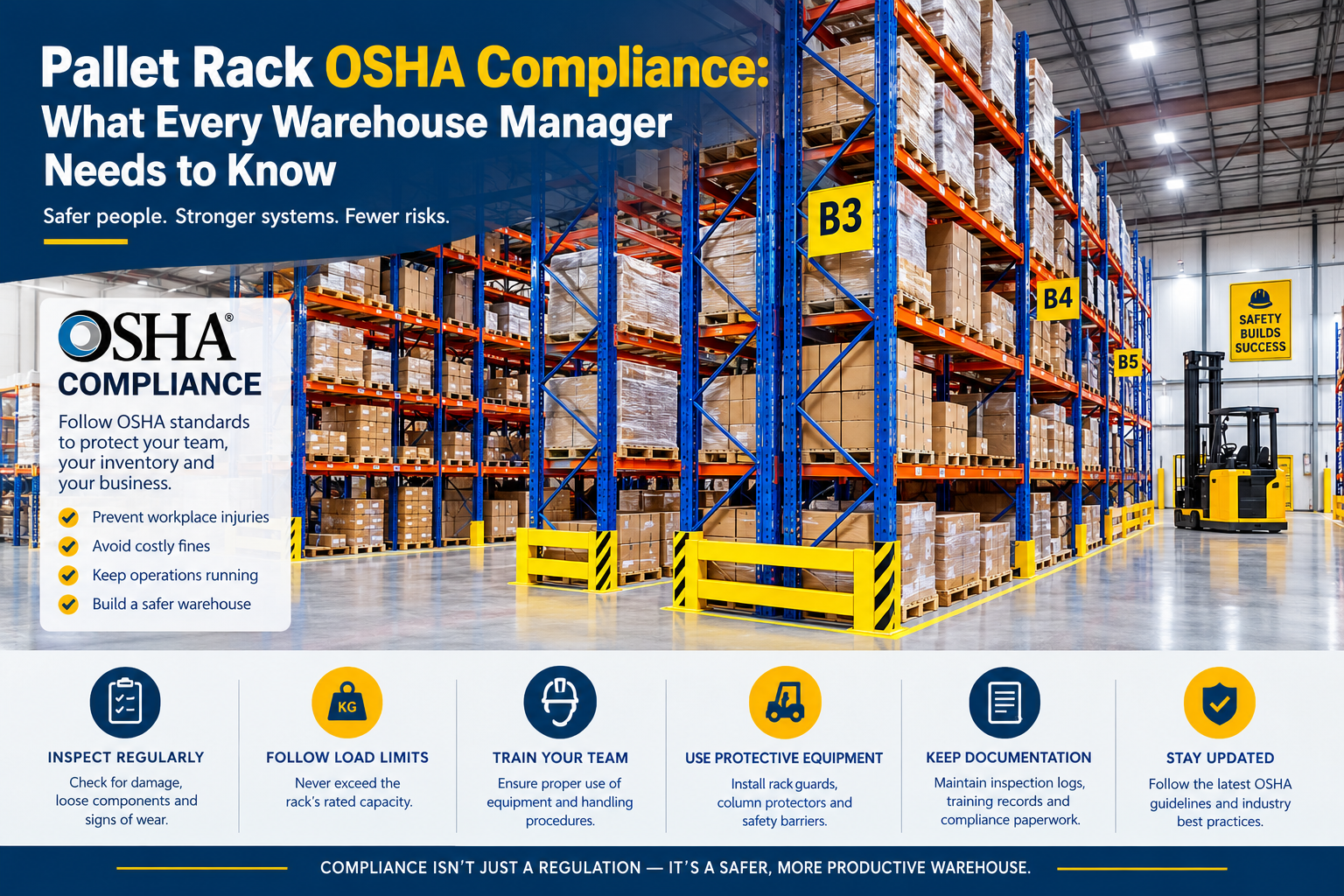
Warehouse pallet racking with safety features, load capacity placards, and inspection points for OSHA compliance
Regulation 1 โ€” The Foundation of All Rack Compliance
OSHA Act
General Duty Clause ยง5(a)(1)
OSHA General Duty Clause โ€” The Baseline Obligation
Requires employers to maintain a workplace free from recognized hazards likely to cause death or serious harm
Applies to All RacksNo Specific Rule RequiredMost Common Citation Basis

The General Duty Clause is the primary mechanism by which OSHA cites pallet rack safety violations โ€” even when no specific regulation explicitly covers a particular hazard. It requires every employer to provide employees with a workplace free from recognized hazards that are causing or are likely to cause death or serious physical harm.

Recognized Hazard
Allowing forklift-damaged uprights to remain in service while loaded โ€” citable even without a specific rack standard covering the situation
Recognized Hazard
Operating without load capacity placards โ€” the industry standard is well-established and OSHA treats absence as a recognized hazard
Recognized Hazard
Overloading rack beyond posted capacity โ€” a foreseeable hazard with a readily available means of abatement
Recognized Hazard
Failing to replace bent uprights after forklift impact โ€” structural failure risk is a recognized consequence of this condition
Key point: "No specific rule covers this" is not a defense under the General Duty Clause. OSHA evaluates whether the hazard was recognized by the employer or the industry, and whether a feasible means of abatement was available โ€” not whether a specific CFR section names the exact condition.
Regulation 2 โ€” Primary Warehouse Storage Standard
OSHA CFR
29 CFR 1910.176
Materials Handling and Storage
Governs how materials are stored, stacked, and secured in warehouse environments
Most Directly ApplicableStacking StabilityClearance Requirements

29 CFR 1910.176 is the most directly applicable OSHA standard for warehouse racking operations. It provides the regulatory basis for several common pallet rack compliance requirements that go beyond the General Duty Clause.

1910.176(b)
Storage stability: "Material stored in tiers shall be stacked, blocked, interlocked and limited in height so that it is stable and secure against sliding or collapse." This is the regulatory basis for requiring safety netting on open rack backs, adequate pallet quality, and correct beam-level spacing to prevent pallet overhang. See pallet rack accessories for netting, guards, and decking.
1910.176(c)
Housekeeping: Storage areas must be kept free from materials that constitute hazards from tripping, fire, explosion, or pest harborage โ€” relevant to maintaining clear aisle paths and preventing floor-level product storage that blocks emergency egress.
1910.176(e)
Clearance signs: "Clearance signs to warn of clearance limits shall be provided." Where rack systems are installed near overhead obstructions, doorways, or low-ceiling areas, clearance warnings must be posted visibly.
Practical note: The requirement that stored materials be "stable and secure against sliding or collapse" is the primary regulatory basis for requiring wire decking, adequate pallet quality checks, and correct pallet overhang management in pallet rack operations.
Regulation 3 โ€” Aisle and Walking Surface Requirements
OSHA CFR
29 CFR 1910.22
Walking & Working Surfaces โ€” Aisle Clearance
Requires permanent aisles to be marked, adequately lit, and kept clear
Aisle MarkingMinimum WidthsLighting Requirements

1910.22 governs general walking and working surfaces including the requirement for permanent aisles to be marked and kept clear. For pallet rack operations, three practical requirements apply directly.

Marking
Permanent aisles and passageways must be appropriately marked โ€” floor marking tape or painted lines delineating rack aisles from pedestrian walkways
Keep Clear
Aisles must be kept clear and in good repair โ€” no product, pallet, or debris across or in the aisle that could create a trip, collision, or egress hazard
Lighting
Minimum 5 foot-candles for general warehouse areas, 10 foot-candles where work is performed at the rack. Verify all beam levels have adequate illumination โ€” insufficient lighting at upper levels is a common citation.
Aisle Width
"Sufficient safe clearances shall be allowed for aisles." For counterbalance forklifts: aisle width = turning radius + load length + 12 inches minimum each side. Check your forklift manufacturer's spec sheet for your specific equipment model. Our warehouse layout planning guide covers aisle widths by equipment type.
Regulation 4 โ€” The Engineering Standard Behind Compliance
ANSI/RMI
MH16.1
ANSI MH16.1 โ€” Industrial Steel Storage Rack Standard
The engineering design standard cited by OSHA as evidence of recognized industry practice
Voluntary but Enforceable via GDCDesign & InstallationLoad Ratings

ANSI MH16.1 is a voluntary engineering standard โ€” but OSHA routinely cites it in General Duty Clause cases as evidence of the recognized industry standard, making practical compliance effectively mandatory. It covers the engineering design, installation, and operational requirements for industrial steel storage racks.

Load Placards
Every rack system must have load capacity placards posted at the end of each aisle showing maximum bay capacity and per-level capacity for the installed configuration. Use our load capacity guide to understand bay vs. beam ratings.
Beam Safety Pins
All beam-to-upright connections must include the manufacturer's specified locking device โ€” generic fasteners are not an acceptable substitute. Warehouse rack safety pins are the standard method of meeting this requirement.
Row Spacers
Back-to-back rack rows must be connected with row spacers to maintain proper back-to-back distance and prevent lateral drift
Anchoring
All uprights must be anchored to the floor with bolts of sufficient diameter and embedment depth to resist calculated base shear and overturning moment โ€” seismic zones have additional requirements
Safety Factor
Structural members must be designed with a 1.67x safety factor โ€” the posted working load limit is 60% of the design failure load, not the maximum before collapse
Regulation 5 โ€” Most Common Compliance Gap
ANSI / OSHA
Load Capacity Placards
Load Capacity Placards โ€” Required at Every Aisle End
The single most commonly cited rack compliance gap in OSHA warehouse inspections
Action RequiredOne Per Aisle EndMust Reflect Actual Config

If you take one compliance action after reading this guide, it should be verifying your load capacity placards. Missing, incorrect, or illegible placards are among the most consistently cited violations in OSHA warehouse inspections โ€” and among the most straightforward to correct.

โฌ› Load Capacity Placard โ€” Required Information
Maximum Bay Capacity
24,000 lbs
Total load all beam levels combined โ€” for this installed configuration
Maximum Per-Level
5,500 lbs
Maximum load any single beam pair can support
Installed Configuration
8-ft bay ยท 20-ft upright
Ratings apply to this specific configuration only
Number of Beam Levels
4 levels
Adding or removing levels requires a new placard
Must be updated after ANY configuration change โ€” beam heights, level count, or component replacement
Walk your facility now: Check every aisle end for a load capacity placard. If any are missing, illegible, or show a configuration that doesn't match what's installed, contact your rack supplier for replacements before your next OSHA inspection. Reconfigured beams also change ratings โ€” see common errors in our pallet rack installation mistakes guide.
Regulation 6 โ€” Fire Safety Requirement
NFPA
NFPA 13
NFPA 13 โ€” Fire Sprinkler System Compatibility
Wire decking is required in most rack systems โ€” solid decking blocks sprinkler coverage and violates NFPA 13
Wire Decking RequiredMax Storage HeightFlue Space Requirements

NFPA 13 governs fire sprinkler system design and installation โ€” and it intersects directly with pallet rack through requirements for water penetration to all stored product levels during a fire event.

Wire Decking
Solid decking blocks sprinkler water from reaching product on lower beam levels โ€” violating your fire suppression system's coverage design. Open-mesh wire decking allows water penetration to all levels and is the required standard choice for virtually all rack applications with overhead fire suppression.
Storage Height
NFPA 13 specifies maximum storage heights by commodity classification (Class Iโ€“IV, Group Aโ€“C plastics). Raising rack height above the height used in your sprinkler system design requires re-evaluation by a licensed fire protection engineer before adding the additional beam level.
Flue Space
NFPA 13 requires longitudinal and transverse flue spaces between stored pallets to allow water penetration from overhead sprinklers to lower storage levels. These are pallet positioning requirements, not rack structural requirements.

Common OSHA Rack Citations โ€” Pre-Inspection Checklist

OSHA inspections of warehouse and distribution facilities consistently identify the same categories of rack violations. Use this as your pre-inspection self-audit checklist, or schedule a pallet rack safety inspection.

Common ViolationApplicable StandardCorrective Action
Missing or illegible load capacity placardsOSHA GDC / ANSI MH16.1Post correct placards at every aisle end before first load
Damaged uprights in service while loadedOSHA GDC / 1910.176(b)Unload, tag out, and repair or replace immediately
Missing beam safety pins on connectionsANSI MH16.1 / OSHA GDCVerify all pins present; replace any missing immediately
Solid decking blocking sprinkler coverageNFPA 13 / OSHA GDCReplace with open-mesh wire decking โ€” consult fire protection engineer
Rack loaded above posted capacityOSHA GDC / 1910.176(b)Redistribute or remove excess load; verify placard accuracy
Uprights not anchored to floorANSI MH16.1 / OSHA GDCInstall anchor bolts per manufacturer specification
No row spacers on back-to-back rowsANSI MH16.1Install row spacers; inspect for lateral drift before reloading
Aisles not marked or insufficient widthOSHA 1910.22(b)Apply floor marking tape; reconfigure if width is insufficient for equipment
No documented inspection programOSHA GDCImplement written inspection protocol with dated, signed records
Inadequate lighting at upper beam levelsOSHA 1910.22(a)Add supplemental warehouse lighting to achieve 5+ foot-candles at all levels

Building Your Rack Compliance Program โ€” 4 Components

Moving from reactive compliance (fixing things when OSHA visits) to proactive compliance (a documented program) is the most effective way to prevent injuries and minimize OSHA exposure. A practical rack compliance program has four components:

๐Ÿ“„
Written Rack Safety Policy
A documented policy stating your organization's commitment to rack safety, assigning responsibility for inspections, and establishing the procedure for reporting and responding to rack damage. Keep this in your safety manual and post it in the warehouse. This document is the first thing an OSHA inspector asks for.
๐ŸŽ“
Operator Training Records
Train all forklift operators and warehouse personnel on what rack damage looks like, how to report it, and the protocol for tagged-out bays. Document training completion with signed, dated records โ€” verbal training with no documentation provides zero protection in an OSHA investigation.
๐Ÿ“‹
Documented Inspection Records
Maintain written records of all rack inspections โ€” daily operator observations, monthly supervisor checks, and annual professional inspections. Documented inspection records are the strongest evidence of a good-faith compliance effort in an OSHA inspection or post-incident investigation. Start with this warehouse racking inspection checklist.
โšก
Rapid Response Protocol
Establish a clear procedure: damage reported โ†’ bay unloaded and tagged โ†’ supplier contacted within 48 hours โ†’ no reload until repair is complete and placard is updated. This protocol, consistently followed and documented, demonstrates the systematic hazard abatement approach OSHA expects.

Frequently Asked Questions

Common questions from warehouse managers about OSHA rack compliance obligations and requirements.

01
Does OSHA require annual pallet rack inspections?
OSHA does not specify an annual inspection frequency in explicit regulatory language. However, the General Duty Clause creates an employer obligation to identify and abate recognized hazards โ€” which in practice requires a systematic inspection program. The industry standard, supported by ANSI MH26.2, is annual professional inspections plus monthly visual inspections by internal staff. Documented inspections are the primary evidence of a good-faith compliance effort. United Rack Solutions offers pallet rack testing and inspection.
02
What happens if OSHA finds damaged rack in my warehouse?
If an OSHA inspector finds bent uprights in service, rack loaded above posted capacity, or missing load placards, the likely outcome is an "Other Than Serious" to "Serious" citation depending on severity. Willful violations can reach $165,514 per violation. Beyond the fine, the inspector issues an abatement requirement with a deadline to correct the violation and submit documentation confirming correction.
03
Does OSHA require load capacity placards on every bay?
The practical compliance standard โ€” based on ANSI MH16.1 and OSHA General Duty Clause enforcement โ€” is one placard per aisle end, posted at a location visible from normal operating positions. In facilities with multiple rack configurations (different upright heights or beam levels), each distinct configuration requires its own placard showing the capacity for that specific installed configuration.
04
Can I use plywood or solid steel decking on pallet rack?
Solid decking is not prohibited by OSHA or ANSI MH16.1, but it typically violates NFPA 13 fire suppression requirements by blocking sprinkler water from reaching lower beam levels. In most commercial warehouse facilities with overhead fire suppression systems, installing solid decking requires re-engineering of the sprinkler system. Open-mesh wire decking is the standard compliant choice for virtually all applications. Compare that option with pallet supports vs. wire decking.
05
Are ANSI MH16.1 requirements legally enforceable?
ANSI MH16.1 is a voluntary standard โ€” it is not itself a law or OSHA regulation. However, OSHA routinely incorporates it into General Duty Clause citations as evidence of the recognized industry standard for rack safety. When OSHA can show that ANSI MH16.1 identifies a practice as standard and an employer failed to follow it, this becomes the basis for a legally enforceable General Duty Clause citation.
06
What should I do immediately after rack is damaged by a forklift?
Four immediate steps: (1) Unload the affected bay immediately โ€” do not leave it loaded while "monitoring" the situation. (2) Mark it clearly with red danger tape or red tags visible to all forklift operators. (3) Contact your rack supplier within 48 hours for an assessment and repair or replacement quotation. (4) Document everything โ€” date, time, location, extent of damage, immediate actions taken. This documentation is critical in any subsequent OSHA inspection or injury claim. Replacement uprights, beams, and pins are available as new pallet racking or from used pallet rack inventory.
Free Compliance Assessment Available

Need Help Bringing Your Rack System Into Full Compliance?

United Rack Solutions helps warehouse operators across Pennsylvania and surrounding states audit rack systems, identify compliance gaps, supply correct load capacity placards, provide and install replacement components, and document systems to meet OSHA and ANSI MH16.1 requirements.

Get a Free Rack Compliance Assessment โ†’
Compliance Gap Identification Load Placards Supplied Replacement Components Available PA & Surrounding States
๐Ÿ“ž
Call Us Direct
(610) 757-0011
๐Ÿ“ง
Email Anytime
sales@unitedracksolutions.com
๐Ÿ“
Location
Sinking Spring, PA โ€” Serving Nationwide
Scroll to Top